

[Column] Touristship — An Essential Perspective for Future Tourism ①
Travelers and Communities Are Actually Two Sides of the Same Coin
In this column, "touristship" is viewed not simply as "improving traveler manners," but as an essential concept for the future of tourism. This perspective reflects the author's own view as a practitioner of sustainable tourism and may not necessarily align perfectly with the official stance of the General Incorporated Association Touristship. We hope this column serves as an opportunity to broaden your perspective on travel and tourism.
*"Touristship" refers to "the attitude and behavior of showing consideration for travel destinations, contributing to local communities, and enjoying interactions." (*1)
Hearing this explanation, some people might feel, "Since it's about traveler manners, it has nothing to do with me as a resident of a community that hosts travelers." However, any of us can become a traveler at any time.
When we think of travel, we tend to imagine overseas trips, but the same applies within Japan. When you travel from Honshu to Hokkaido, Shikoku, Kyushu, Okinawa, or other remote islands, you are a traveler to that host region. This is true not only when traveling outside your prefecture, but also in more familiar examples, such as when visiting a neighboring municipality. During the COVID-19 pandemic, the term "micro-tourism" became widely known. Even without traveling far, many people rediscovered new charms by visiting nearby areas. Even in these close-to-home movements, we interact with communities as travelers.
Furthermore, touristship is not something that matters only when we change locations.
For instance, while traveling domestically, you might encounter travelers from overseas. They might engage in behavior that looks like a breach of manners because they do not know Japanese culture or customs. However, they may mean no harm and might simply be acting based on the norms and habits of their own country.
In such situations, you are on the "hosting side." This is because, from the perspective of Japan as a whole, you are a member of the community welcoming that traveler.
If you understand the concept of touristship, instead of simply feeling uncomfortable or angry about their behavior, you might be able to accept it with tolerance, thinking, "Perhaps they just didn't know." You might also be able to gently strike up a conversation, perhaps referring to guidelines like the Touristship Action Guide (*2). If a small interaction begins there, it could become an unforgettable memory of Japan for that traveler. It may also foster a sense of respect and affection for Japan and the regions they visit.
This is precisely international exchange through touristship. If that traveler talks about their experience with family and friends after returning home, the circle of touristship will naturally spread across the world.
Such relationships are not limited to interactions between Japanese people and foreign visitors. For example, if I, a native of Niigata Prefecture, meet tourists from outside the prefecture during my visits back home and see them struggling because they don't understand local culture or customs, I might be able to offer a helping hand. However, even within the same Niigata Prefecture, people who live in that specific locality know their area best. I myself have many opportunities to learn new things from the local residents.
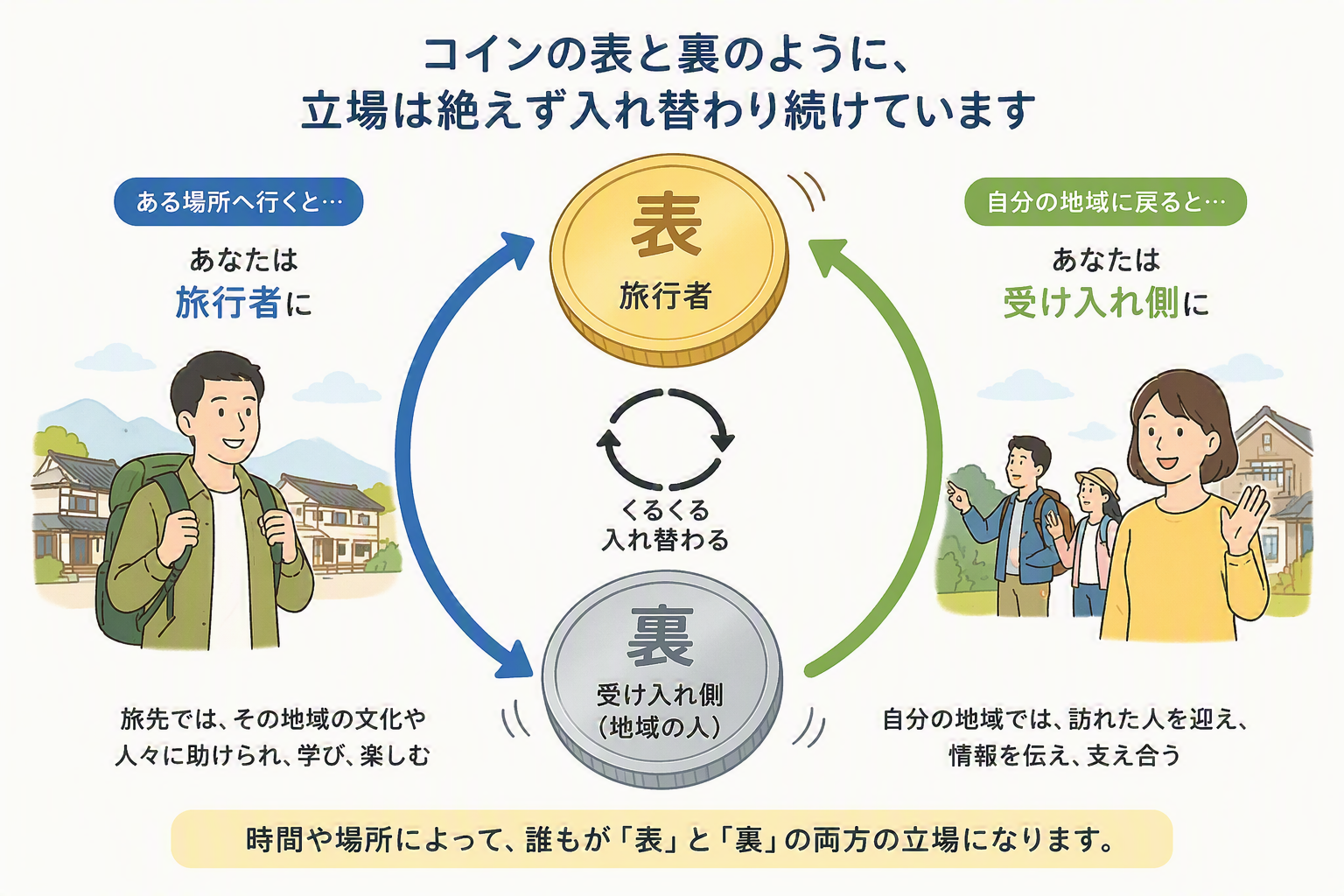
In other words, touristship is not a fixed relationship between "travelers" and "hosts." Depending on the place and situation, we can be travelers, and we can also be on the side that welcomes communities. Our positions are constantly swapping, just like the heads and tails of a coin.
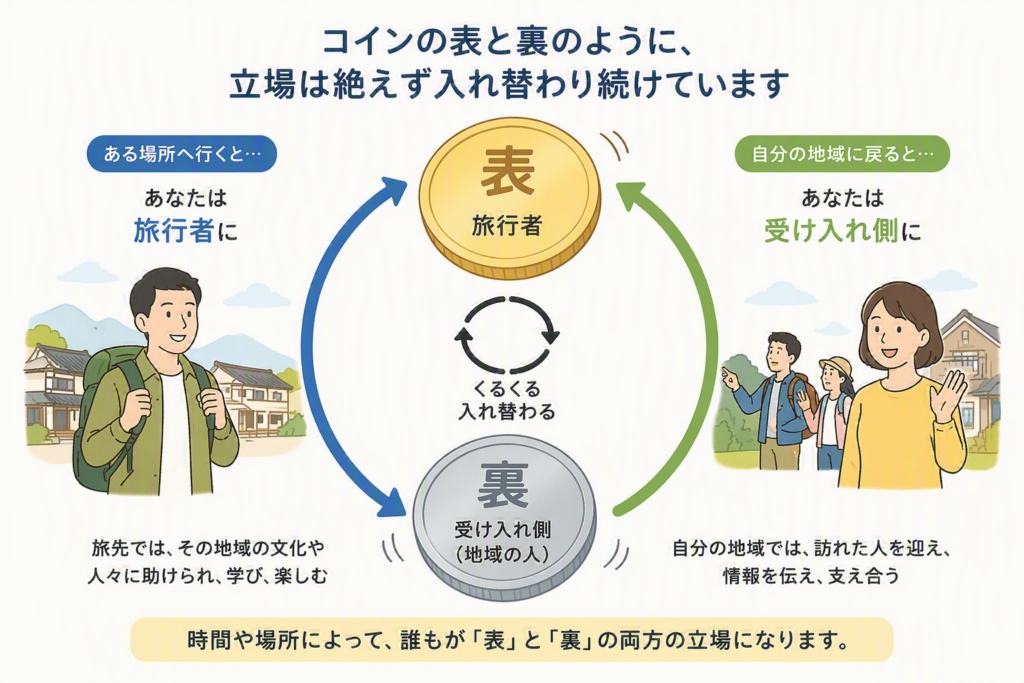
That is why the "attitude and behavior of showing consideration for travel destinations, contributing to local communities, and enjoying interactions" is not something required only of travelers. When each and every one of us adopts this mindset, our travel experiences become richer, and our encounters and learning with people deepen.
Touristship is not merely a mindset for travel destinations; it is a way of thinking that enriches our own lives.
Takeaki Shibuya JARTA (Japan Alliance of Responsible Travel Agencies)
――――――――――――――――――――――――――――――――――――――
出典・注