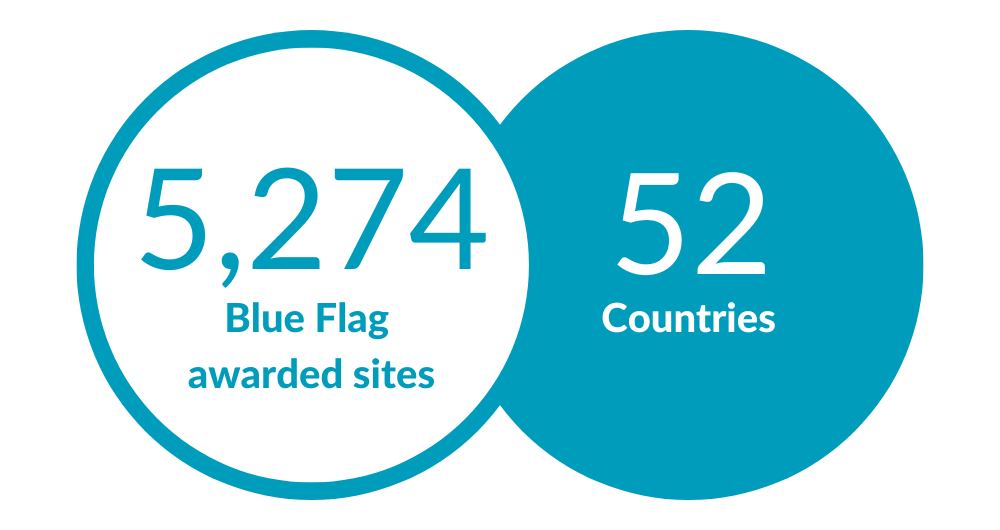
*Click (or tap) on the map or any Blue Flag logo to zoom in/out and view details about each certified beach or marina.

The Blue Flag is the world’s longest‑established international certification program for beaches, marinas, and tourism boats, operated by the Foundation for Environmental Education (FEE). It is awarded only to locations that meet all of the strict criteria set for each category across four areas: water quality, environmental education, environmental management, and safety & services.
JARTA is the only officially appointed National Operator of the Blue Flag program in Japan, delegated by the Foundation for Environmental Education (FEE). It holds full authority over certification assessments and standards management within Japan, ensuring the integrity of the Blue Flag through fair and rigorous evaluations. JARTA also works in partnership with the Japan Blue Flag Association for outreach and educational activities.


The Blue Flag program promotes sustainable development for beaches, marinas, and tourism boats through strict criteria (Note 1) across four key areas: water quality, environmental education and information, environmental management, and safety and services.*(Note 1: Required criteria are set according to the characteristics of each category.)*

Blue Flag beaches meet all of the international standards in the following areas.


As the National Operator, JARTA advances the following missions.
1. Promotion of environmental programs: Encouraging the implementation of high‑quality environmental education programs for users of beaches, marinas, and tourism boats.
2. Establishment and evaluation of management systems: Supporting and assessing administrators and stakeholders in deepening their understanding of environmental management systems and safety and service standards, and ensuring their effective implementation.
3. Minimizing environmental impact and monitoring: Ensuring continuous monitoring and providing appropriate information to minimize the impact of visitor activities on the natural environment.
4. Promoting understanding of coastal environments: Supporting activities that deepen awareness of the coastal environment and ecosystems surrounding beaches.
5. Contributing to sustainable tourism development: Working in collaboration with local communities to promote tourism development that balances environmental protection with economic vitality.
6. Integrating environmental perspectives into governance: Promoting the incorporation of environmental considerations as an essential element in the decision‑making processes of municipalities and stakeholders.

To ensure the credibility of the Blue Flag program, JARTA operates in accordance with the following principles.
・Authority as the National Operator: JARTA is the sole organization in Japan authorized to conduct the final evaluation and submit recommendations to the international headquarters.
・Independence of the evaluation: Assessments are conducted objectively by a national evaluation committee that includes external experts.
・Ensuring fairness: Whether or not an applicant uses the support services provided by the Japan Blue Flag Association has no influence on the evaluation results. By separating the evaluation body (JARTA) from the support organization (the Association), a high level of transparency and governance consistent with international standards is maintained.

To obtain Blue Flag certification, local governments and the managers/operators of beaches or marinas must take the lead in meeting the required criteria established across four categories: water quality, environmental education and information, environmental management, and safety and services.
For those considering applying for beach certification: Beaches often involve a wide range of stakeholders. To ensure a smooth certification process, please conduct sufficient discussions and coordination within the community in advance, determine the “applicant organization (the primary contact),” and then contact JARTA.
to begin the application process to JARTA, the national operating organization.
(for those who wish to do so). JARTA provides procedural guidance
as needed.
(for those who wish to do so). ・Applicants can receive specialized support
in outreach, education, and certification assistance.
・Support fees are independently set by the Association.
(This is separate from the evaluation fee.)
*Held every January.
(held once a year).
Following the recommendation from the National Jury, the International Jury makes the final decision.
A certificate and the Blue Flag are presented by JARTA, and the site is listed as a certified location on both the JARTA and international headquarters websites.
1. Application to begin the process (contact JARTA): All applicants, regardless of whether they request support, must first contact JARTA.
2. Preparation and document creation: The municipality takes the lead, or applicants proceed with preparation toward meeting the criteria while receiving support from the Japan Blue Flag Association.
3. Submission of documents and national review: JARTA conducts a rigorous review based on international criteria.
4. International review and certification: Sites that pass the national review are recommended by JARTA to the international headquarters (FEE), where the final certification decision is made.

To ensure transparency in the evaluation process, the costs associated with obtaining and maintaining the Blue Flag are completely separated as follows.
All prices listed below include tax.
※In principle, payment is made after the submission of the application (in November).
330,000 yen per year
・Review fees (paid to JARTA): These are the costs required for the official evaluation and registration based on international standards.
• Support fees (paid to the Japan Blue Flag Association): These costs apply only if applicants request specialized advice or support for environmental education. Use of this service is optional and is not related to the evaluation process.

All prices listed below include tax.
JARTA, which is responsible for the evaluation process, and the Japan Blue Flag Association, which handles promotion and support, work in cooperation; however, their roles and authorities are clearly distinct.
| Cost categories |
Responsible organization |
Description |
| Review and application fees | JARTA | Official evaluation fees based on international rules (330,000 yen per year) |
| Support and consulting fees | Japan Blue Flag Association | Costs incurred when requesting specialized support or educational activities for obtaining certification |

Blue Flag is a certification that indicates beaches and marinas meet international standards for safety, environmental protection, education, and management systems. However, its value goes far beyond simply proving that the water is clean. Blue Flag serves as a powerful driver for shaping the future of local communities.
1. Fostering civic pride within the community
Beaches and marinas recognized internationally become symbols of the community, strengthening residents’ pride and sense of attachment. As people grow more conscious of protecting their local coastline, this awareness becomes a driving force for sustainable community development.
2. Creating opportunities for education and learning
Blue Flag places strong emphasis on environmental education, providing opportunities for people of all ages—from children to adults—to learn about ocean safety and the natural environment. When local schools and organizations incorporate the coast into their learning activities, it helps nurture the next generation of ocean stewards.
3. Strengthening local collaboration and governance
Obtaining certification requires collaboration among local government, businesses, and residents. This process itself strengthens community partnerships and builds a foundation for community development centered around the coast.
4. Promoting sustainable tourism
Because Blue Flag is trusted worldwide, it enhances the reputation of a destination as an environmentally responsible tourism site and attracts high‑quality visitors. This, in turn, brings long‑term benefits to the local economy.
Blue Flag not only protects the beauty of the coastline but also serves as a shared goal for shaping the future of the community. Obtaining certification is not the finish line—it is the starting point for the entire region to grow together with the sea.

Q: Is it impossible to apply without receiving support from the Japan Blue Flag Association?
A: No, you can. All applicants may submit their application directly through JARTA, the national operator, regardless of whether they use support services or not.
Q: Does receiving support give any advantage in the evaluation process?
A: No, it does not. The evaluation is conducted independently based on international standards set by FEE. Information regarding whether support was used is completely excluded from the review process, ensuring a strict separation of information.