JARTA is Japan's only Blue Flag National Operator accredited by FEE (Foundation for Environmental Education).
| Organization | Role |
|---|---|
| FEE(Foundation for Environmental Education) ブルーフラッグのプログラムを運営する国際本部。FEEは、1981年に設立され、85か国以上に110を超える加盟団体を有する、世界最大級の環境教育組織の一つです。 | International Headquarters |
| Japan Alliance of Responsible Travel Agencies | National Operator |
| Municipalities & Site Managers | Certification Holder |
| Japan Blue Flag Association | Promotion & Acquisition Support |
Our choices will change the future of the ocean.
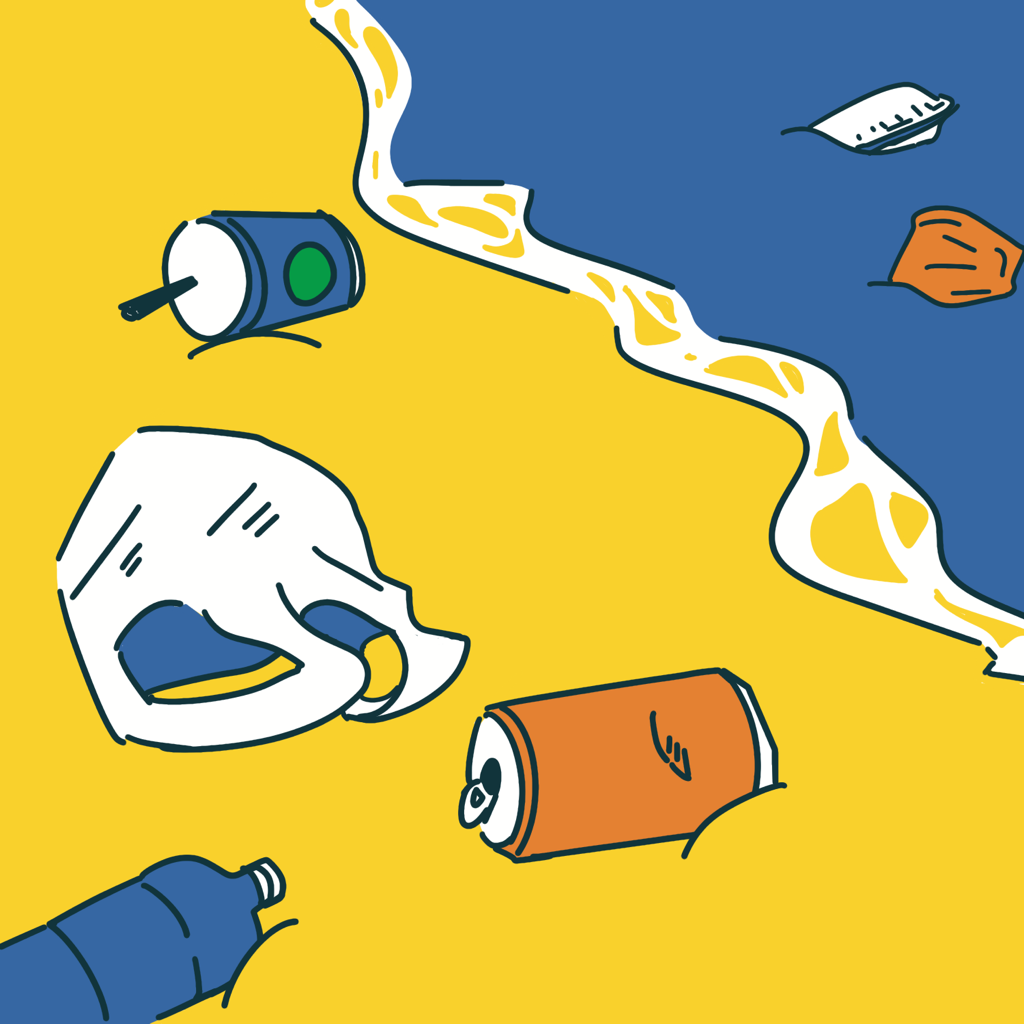
The ocean is the source of all life, a place that has always healed and comforted us. Today, however, our oceans are facing an unprecedented crisis. Countless pieces of washed-up waste, rising water temperatures, and the drastic depletion of marine life—the consequences of our activities on land are becoming a harsh reality right at our feet.
What we must protect now is not just the sea or the sandy beaches. The "Blue Flag," a globally recognized symbol of trust, is more than just an environmental conservation initiative. It serves as a powerful means of "regional preservation"—rediscovering local charm, fostering civic pride, and building a strong collaboration among all residents and business operators connected to the ocean.
In Europe, which leads this movement, opening a map reveals Blue Flag beaches lining the coasts so densely they seem to fill the entire shoreline.
The blue flag is proof of protecting the ocean. And it is a marker of the future we should aim for.
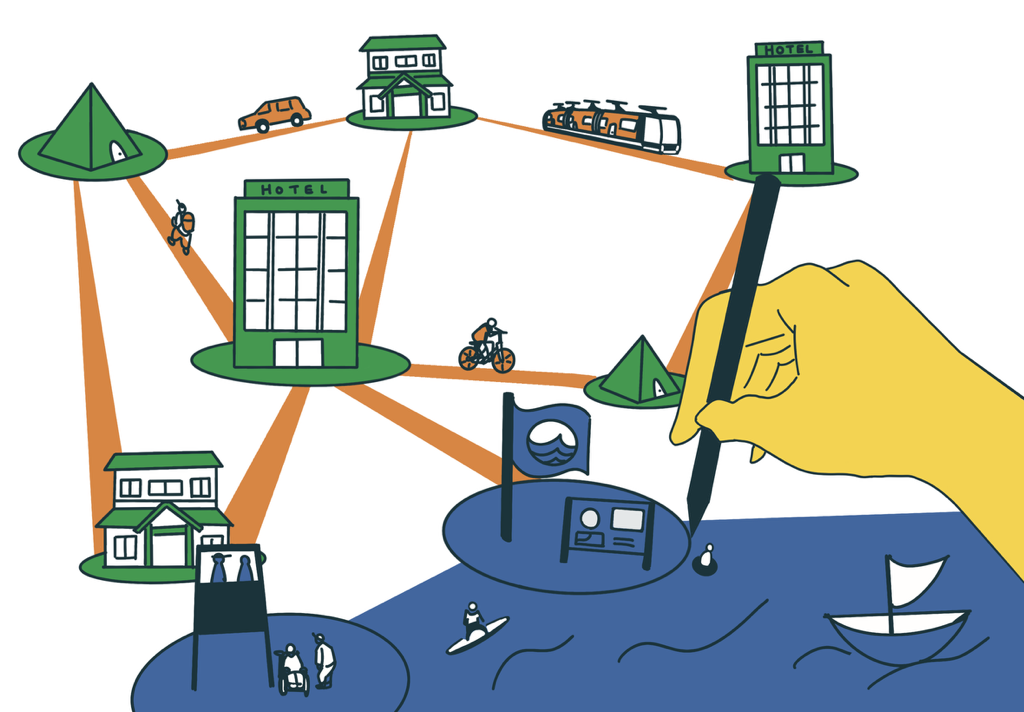
Area: Integrated
Destination
Management
Protecting the Community Through Holistic Optimization
The world's most historic sustainable standard for the ocean.
Born in France in 1985 and currently operated by the Foundation for Environmental Education (FEE), Blue Flag is the world's most historic and prestigious international eco-label. It is awarded only to locations that clear extremely rigorous criteria to protect the beauty of the ocean and sandy beaches.
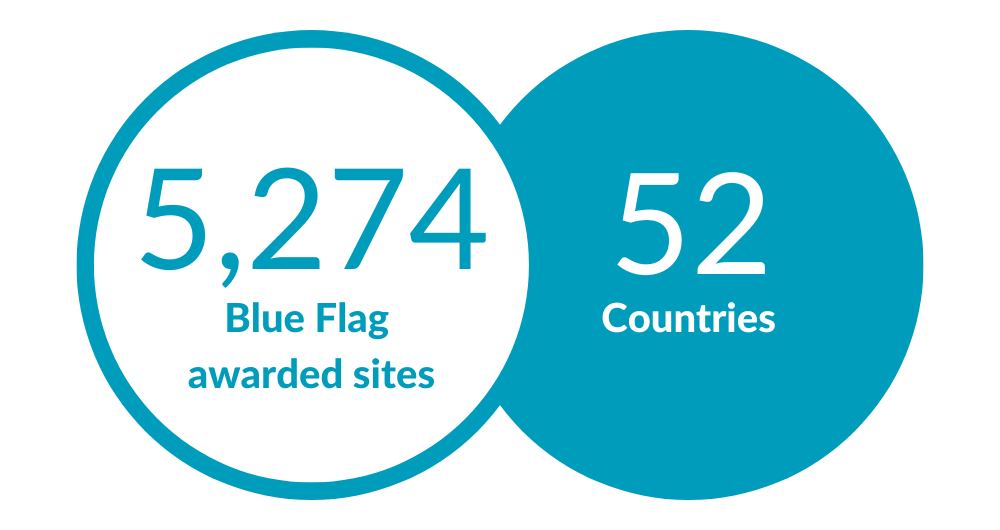
Currently, the certification has been obtained by more than 5,200 locations across over 50 countries worldwide. The scope extends beyond just beaches (swimming areas) to include marinas where yachts and boats dock, as well as sustainable boating tourism operators (such as cruise ships). Every stage connected to the sea is taking on the challenge for this shared future.
It is not chosen simply because it is beautiful or safe. It is a system for truly sustainable ocean development that requires "meeting all" strict certification standards across water quality, environmental education, safety, and management systems.
History of Blue Flag
| 1985 | An environmental education project launched in France where 1,000 children released "bottles filled with letters" into the sea. The "blue flag," which served as the symbol for this activity proving that pollution spreads globally via ocean currents, became the origin of Blue Flag. |
| 1987 | With support from the European Commission, the certification system officially started as the "European Blue Flag." The first certifications were implemented at 244 beaches and 208 marinas across 10 European countries. |
| 2001 | With South Africa joining, the system evolved from a Europe-limited program into a "globally shared international certification program" in both name and substance. |
| 2014 | The international scale expanded to the point where Blue Flag was implemented in 50 countries worldwide |
| 2016 | The first Blue Flag in Japan and Asia was born. "Yuigahama Beach" in Kamakura City, Kanagawa Prefecture, and "Wakasa Wada Beach" in Takahama Town, Fukui Prefecture, obtained certification simultaneously. |
| 2022 | In addition to "Zushi Beach" in Zushi City, Kanagawa Prefecture, "Riviera Zushi Marina" achieved the milestone of becomingthe first marina in Asia to acquire the certification. |
| 2026 now | It has grown into one of the world's largest environmental certifications, deployed at over 5,000 beaches and marinas across more than 50 countries. With JARTA serving as the domestic secretariat, the number of certifications within Japan has expanded toa total of 15 locations (12 beaches, 3 marinas). |
List of Blue Flag Certified Facilities
List of Certified Facilities
※ Clicking or tapping the map or each Blue Flag logo allows you to zoom in/out of the map and check information about the certified beaches (marinas).
Is a "trash-free beach" really a clean ocean?
We tend to assume that if there is no trash left on the sand, it is a "beautiful ocean." However, the true crisis the ocean currently faces is progressing silently in places unseen to our eyes and on a scale beyond our imagination.
Although advanced beaches in Japan are taking steps toward the future bit by bit, the country as a whole is still just getting started. Here are the "four realities of the ocean" that we must seriously face today:

1. Massive Amounts of Waste Outpacing Collection
An enormous amount of man-made waste washes ashore on Japanese coastlines every year. The clean sandy beaches we see are maintained only through a constant, borderline "cat-and-mouse game" between the endlessly arriving trash and the tireless efforts of volunteer cleanups.

2. Changes in water quality hidden behind the "visible blueness"
Even if the seawater looks crystal clear and beautiful at first glance, the invisible proliferation of bacteria and pollution from land-based runoff are steadily eroding the marine ecosystem. True safety cannot be measured by superficial cleanliness alone.

3. "Artificial beauty" that leaves ecosystems behind
Forcible and complete removal of natural seaweed and driftwood for the sake of tourists makes the beach look clean for a moment, but it actually destroys the habitats of tiny creatures on the shore and disrupts the natural cycle.

4.Vanishing creatures
Due to rising ocean temperatures and invisible environmental changes, the fish, shellfish, and seaweeds that used to naturally be there are silently disappearing, and the very color and balance of the ocean are beginning to change.
The Blue Flag becomes a symbol of local pride (Civic Pride).
Acquiring the Blue Flag and continuing to maintain it every year. That very process serves as a powerful driving force to unite tourism operators involved with the ocean, the surrounding communities, and the people living there as one, nurturing a sustainable region.
The promises in the four fields defined by Blue Flag do not just beautifully restore the ocean; they return unprecedented value to the regions and people taking on the challenge.

1. Safety: Constant presence of lifeguards and barrier-free access that excludes no one
Highly trained lifeguards are stationed at all times, and a flawless medical and rescue system is established. Furthermore, by creating approaches where even wheelchair users can enjoy the ocean, a solid sense of security and pride is born in the community as "a town with the gentlest ocean that leaves no one behind."

2. Environmental Education: Making the ocean a "living textbook" to nurture children's futures
Throughout the year, diverse environmental programs that anyone can join are implemented in the community. Through workshops in cooperation with local schools and experiences involving tourists, the next generation of the community grows into active participants who protect the ocean themselves.

3. Environmental Management: Branding as a globally recognized "Blue Flag Town"
Consistently clearing the strict annual checks of the Foundation for Environmental Education (FEE) is no easy feat. Because of this, a sandy beach flying the blue flag becomes a world-class premier brand, boosting the region's recognition and tourism value over the medium to long term.

4. Water Quality: Returning true peace of mind proven by science
Making all data from regular water quality tests fully public guarantees safety with absolute transparency. This thorough attitude itself returns value to surrounding tourism operators, restaurants, and residents as "the most reliable ocean anywhere."
Come, gather under the Blue Flag.
Efforts to protect the beautiful ocean are by no means the job of regions and operators alone. Choosing the place where the blue flag flutters—that itself is the most beautiful and powerful declaration of intent you can make as a traveler.
To hand over that endless blue that captured your heart to the next generation.
On your next trip, please look for the "Blue Flag" mark. Visiting those beaches and touching those waters will be a wonderful sign of your support, showing that you choose a sustainable future and stand with the communities dedicated to protecting our oceans.
【Voices we want you to deliver together】
At JARTA, we are making a “Sustainable Declaration” to create the future together not only with operators but with all people who love the ocean and travel.
“I want to leave that beautiful ocean just as blue tomorrow.” Instead of leaving that thought entirely to the local region, why not declare it to the world in your own words?
Your small signature will become a large wave that changes the way ocean tourism should be from now on. Please deliver your voice to us as a fellow companion of sustainable travel.